
How Often Should You Work Out? The Optimal Weekly Schedule

"How often should I work out?" is one of the most common fitness questions and the answer isn't one-size-fits-all. Your optimal training frequency depends on your goals, recovery capacity, training style, and life circumstances.
Too little training produces minimal results. Too much leads to overtraining, injury, and burnout. Finding your sweet spot maximizes progress while remaining sustainable.
The Science of Training Frequency
Training creates stress that triggers adaptation. But adaptation doesn't happen during training — it happens during recovery. Your workout breaks down; rest builds up.
The training-recovery-adaptation cycle:
1. Training stimulus (stress on body systems) 2. Recovery period (repair and regeneration) 3. Supercompensation (body adapts to handle greater stress) 4. Next training session (builds on adaptation)
Train again before recovery completes: inadequate adaptation, potential regression. Wait too long after full recovery: miss the supercompensation window. Timing matters.
Frequency by Goal
General Fitness and Health
Recommendation: 3-4 sessions per week
For most people seeking improved fitness, body composition, and health, 3-4 sessions weekly is optimal. This provides sufficient training stimulus with adequate recovery.
At BoxFit Studios, most members train 3-4 times per week and see consistent progress.
Fat Loss
Recommendation: 4-5 sessions per week
Fat loss benefits from higher training frequency (more calorie burn) combined with appropriate nutrition. However, all sessions needn't be high-intensity:
- 3 high-intensity sessions (boxing, HIIT) - 1-2 lower-intensity sessions (walking, yoga, light conditioning)
The mix provides calorie burn while allowing recovery from intense work.
Muscle Building
Recommendation: 4-5 sessions per week
Muscle building requires training each muscle group 2-3 times weekly for optimal protein synthesis stimulation. This can be achieved through:
- Full-body sessions 3x weekly - Upper/lower split 4x weekly - Push/pull/legs 5-6x weekly
Boxing provides some muscle-building stimulus but is primarily cardiovascular. Those prioritizing muscle might complement boxing with dedicated strength work.
Athletic Performance
Recommendation: 5-6 sessions per week
Athletes often train more frequently, but with careful periodization:
- Not all sessions are maximum intensity - Training varies (skill work, conditioning, recovery) - Periodization prevents overtraining - Recovery becomes a serious priority
Maintenance
Recommendation: 2-3 sessions per week
If you've achieved fitness goals and want to maintain rather than progress, 2-3 sessions weekly can sustain results with minimal time investment.
Signs You're Training Too Much
Overtraining is real. Watch for:
- Persistent fatigue despite adequate sleep - Performance declining rather than improving - Frequent illness or injury - Loss of motivation for training - Sleep disturbances - Mood changes (irritability, depression) - Elevated resting heart rate
If you notice these signs, reduce frequency and intensity. More training isn't always better training.
Signs You Could Train More
Undertraining is also possible:
- Progress has stalled despite consistent training - Full recovery between sessions (not even mild soreness) - Energy and motivation remain high - Sleep and mood unaffected - Feeling like you "could do more"
If you're recovering easily and not progressing, adding a session may help.
The Recovery Equation
Training frequency depends on recovery capacity. Factors affecting recovery:
Sleep: 7-9 hours supports recovery. Less means slower adaptation, requiring lower training frequency. This is non-negotiable — sleep is where adaptation happens. Chronic sleep deprivation will make even perfect training frequency produce minimal results. Members training 4x weekly with good sleep progress faster than those training 5x weekly while sleeping only 5-6 hours.
Nutrition: Adequate protein and overall calories support recovery. Under-eating impairs recovery. If you're training frequently while restricting calories significantly, you're fighting your own recovery. Each additional training session increases daily caloric expenditure by 200-400 calories (depending on intensity) — this must be accounted for in total daily intake.
Stress: Life stress adds to training stress. High-stress periods may require reduced training. Your nervous system doesn't distinguish between work stress and training stress — both consume recovery resources. During high-stress work periods, consider dropping from 4 sessions to 3. Conversely, during less demanding periods, you can handle higher frequency.
Age: Recovery slows with age. Older athletes often benefit from lower frequency with higher quality sessions. A 50-year-old athlete recovering in 72 hours vs. 48 hours doesn't necessarily train less frequently, but spacing becomes more important.
Training experience: Beginners recover faster from lighter loads but also have less training tolerance. Advanced athletes tolerate more but also create more damage requiring recovery. This paradox explains why beginner programs use higher frequency (less damage per session) while advanced programs sometimes use lower frequency (more damage per session, requiring more recovery).
Session intensity: High-intensity sessions require more recovery than moderate ones. A week of 4 intense boxing sessions requires different recovery than 2 intense sessions plus 2 moderate sessions. The recovery demands aren't linear.
Progressive Overload and Frequency
A common misconception: higher frequency automatically means better results. Not necessarily. What matters is progressive overload — gradually increasing training stimulus over time. You can achieve this through:
- Increased frequency: More sessions per week - Increased volume: More rounds, sets, or reps per session - Increased intensity: Working harder per session - Improved technique: Same effort, better execution
The best approach uses a mix. You might maintain 3 sessions weekly while increasing rounds per session. Or keep sessions moderate while increasing to 4 weekly. The key is systematic progression, not just more training.
Many members find their sweet spot by experimenting with frequency while controlling other variables. Start at 3x weekly, track progress for 4 weeks, then consider adjusting. This methodical approach reveals what your body responds to.
Scheduling Your Week
Effective weekly scheduling considers:
Spacing: Don't train the same muscle groups on consecutive days. For full-body training (like boxing), allow at least one day between intense sessions.
Recovery days: Include at least 1-2 complete rest days or active recovery days weekly.
Life integration: Schedule training at times you can actually maintain. Consistency trumps optimal timing.
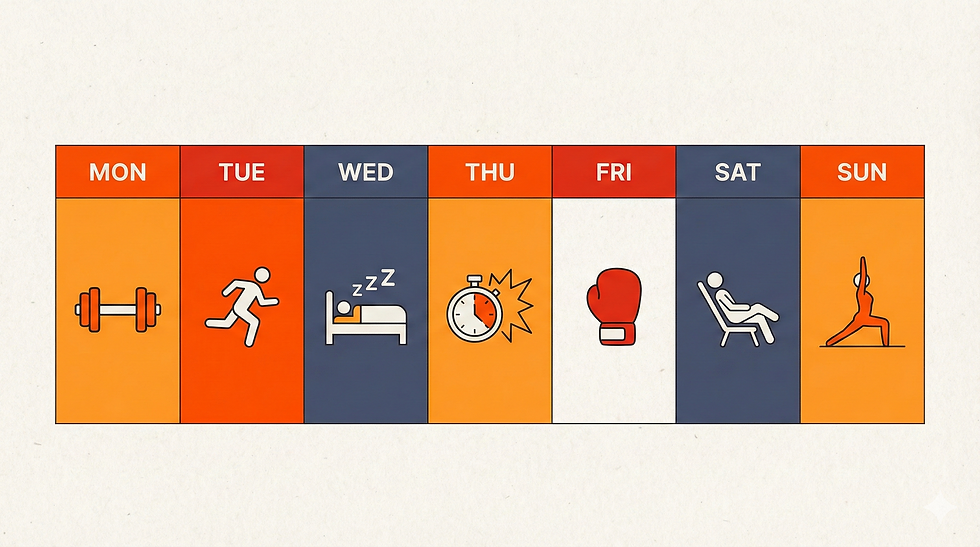
Sample Schedules
3x per week (beginner/maintenance): - Monday: Boxing - Wednesday: Boxing - Friday: Boxing - Other days: Rest or light activity
4x per week (general fitness): - Monday: Boxing - Tuesday: Light activity/yoga - Wednesday: Boxing - Thursday: Rest - Friday: Boxing - Saturday: Boxing or strength - Sunday: Rest
5x per week (dedicated training): - Monday: Boxing - Tuesday: Strength or conditioning - Wednesday: Boxing - Thursday: Active recovery - Friday: Boxing - Saturday: Strength - Sunday: Rest
Our packages accommodate various training frequencies.
Quality vs. Quantity
Frequency matters, but session quality matters more. Four excellent sessions beat six mediocre ones.
High-quality session characteristics: - Full mental engagement - Appropriate intensity - Good technique - Complete focus during training - Proper nutrition/hydration
If you can't achieve high quality, reduce frequency rather than accumulating poor sessions.
Finding Your Optimal Frequency
Start conservatively and adjust:
1. Begin with 3 sessions weekly 2. Maintain for 3-4 weeks 3. Assess: recovery, progress, sustainability 4. Add or subtract based on response 5. Reassess periodically
Your optimal frequency may change over time as fitness, life circumstances, and goals evolve.
For individualized guidance, our personal training option provides customized programming.
FAQ
Can I work out every day?
Technically yes, but not every day at high intensity. Daily training requires mixing intensities and modalities — some days hard, some days easy. For most people, daily training isn't necessary or optimal.
What if I can only train twice per week?
Twice weekly provides benefits, though progress will be slower than higher frequency. Make those two sessions count — full effort, complete focus.
Should I train when sore?
Mild soreness is fine — often training helps. Severe soreness or pain suggests need for recovery. Learn to distinguish "good sore" (mild, diffuse) from "bad sore" (sharp, localized, persistent).
How do I maintain fitness during busy periods?
Reduce frequency while maintaining some training. Even one session weekly preserves more fitness than zero. Brief, intense sessions maintain conditioning better than long, moderate ones during time constraints.
Does training the same thing every day hurt?
For most activities, yes — recovery is needed. Exception: skill practice at low intensity can happen frequently. You can practice boxing technique daily if intensity is low; you shouldn't do intense bag work daily.


Comments